Building Next-Gen AI Companions: A Modern Approach to Intelligent App Development
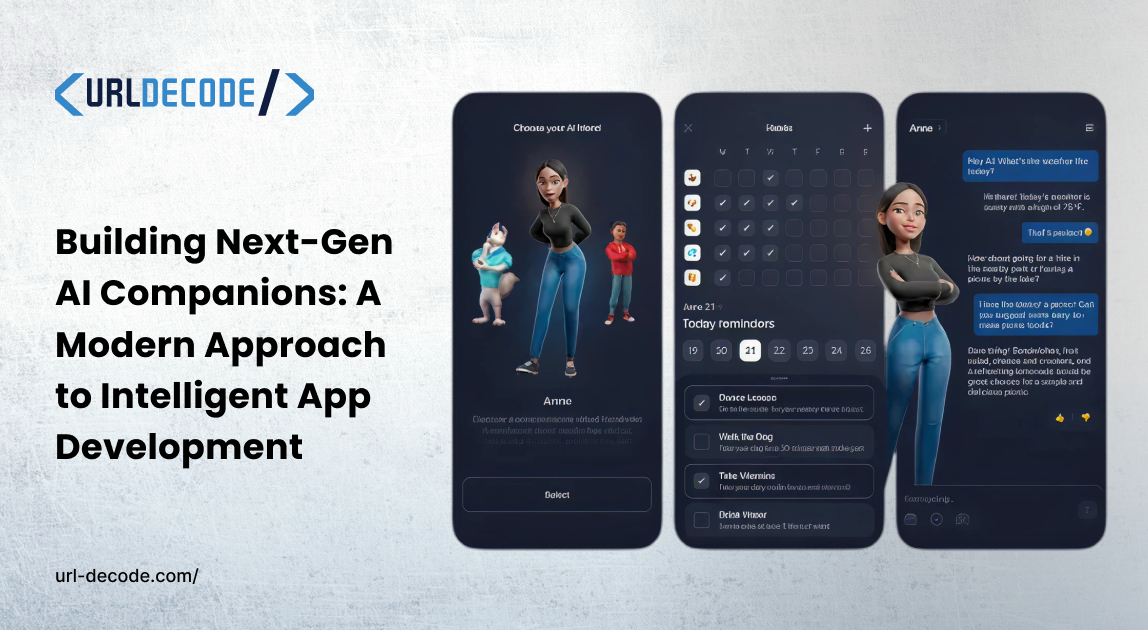
Hyper-personalization of the digital world is still a trend, and one of the most influential technologies in this aspect is AI companion technology. Current users anticipate that mobile apps should not only be functional but also interesting, intuitive, and connect well with them.
This change has led companies to reconsider their approach to digital experiences, and the development of AI companion apps has taken a strategic place for progressive brands. Next-generation AI companions are more intuitive, adaptive, and user-centered than ever, thanks to the improvements in cognitive AI, emotion modeling, natural language processing, and contextual intelligence.
A mature AI mobile development company provides the combination of engineering skills, AI frameworks, data infrastructure, and UX intelligence needed to develop companion apps that can be used on a deep level.
These applications are now finding applications in the fields of wellness, education, productivity, relationships, entertainment, customer experience, and personal development. The need for advanced engineering techniques has been increasing as more industries appreciate the importance of digital companionship.
Understanding the Modern Landscape of AI Companion Technologies
Current AI companions are developed on complex architectures comprising language comprehension, emotional intelligence models, behavior prediction, and context learning. In contrast to simple chatbots, the next-generation AI assistants can read attachments, learn conversational features, have long-term memory, and provide more personalized interaction over time.
These improvements can be made due to the advancement in generative models, neural networks ,and context-aware machine learning structures.
Building these intelligent systems requires a combination of AI engineering, cloud infrastructure, and user experience design. Businesses can also explore mobile app development services to plan and build scalable mobile experiences that support these technologies.
In order to provide those smart systems, currently, the development of AI companion apps demands a more holistic approach, combining AI engineering, cloud-based infrastructure, and mobile experience design.
It also brings in voice interfaces, multimodal comprehension, a personalized avatar engine, and personalization layers that change according to the user's interactions. The outcome is a more humane, intimate relationship that is more authentic than contrived.
The API Integration with Third Parties is one of the key factors driving the development of modern artificial intelligence companions. Whether it's a voice-synthesizing API, an emotion detector, a translation API, a health tracker, or a productivity app, these integrations allow applications to deliver richer functionality without building every feature from scratch. Partnering with an App Development Company ensures these third-party APIs are integrated securely and efficiently, resulting in scalable, high-performing AI applications with enhanced user experiences.
Essential Technologies behind Next-Gen AI Assistants.
The conversational experience is built on a well-crafted architecture, which provides intelligent interactions at scale. Modern companion apps are based on the interplay of natural language processing, machine learning pipelines, and multimodal frameworks that enable them to comprehend both text and voice inputs.
The technologies assist apps in identifying the intent of the user, making tone adjustments, and having more interactive conversations.
With advanced generative AI models, companions can generate spontaneous, context-aware responses rather than using predefined scripts, a capability typically built with specialized LLM development services. These models never give up but continuously learn and refine their behavior so that after some time, the companion can be more structured to the preferences of the users.
These systems are also flexible such that companions are able to provide responses in varying levels of conversation, be it factual, humorous, motivational, or emotional.
Companions based on AI can provide high accuracy of real-time response because of cloud-based infrastructure. It also maintains massive data processing, user interaction history, and dynamic levels of personalization.
All these components combine to create a unified and dynamic system with the ability to have meaningful interactions. Next-generation AI companions rely heavily on real-time communication to deliver human-like interactions. This requires backend systems capable of handling multiple concurrent requests with minimal latency. Event-driven architectures built with Node.js are commonly used for this purpose, making reliable Node.js hosting an essential part of ensuring fast, responsive, and scalable AI-driven conversations. A custom development company plays a crucial role in bringing all these elements together. By designing tailored AI architectures, integrating proprietary datasets, and aligning conversational logic with specific business goals.
Human-Like Companionship Experience Design.
The experience of building an interesting AI companion does not come with the creation of a working chatbot. The emphasis is placed on the creation of a conversational format that is natural, empathetic, and emotionally sensitive. This includes controlling tone, personality, conversation, and adaptive learning patterns.
The fact that an AI companion can change its mode of conversation depending on the mood and preferences of the user is paramount in terms of engagement in the long term.
Developers should also plan the user journey in a way that makes it seem coherent, changing, and personal. This is the place where the emotional intelligence model, behavior mapping, and conversation pattern recognition fit in.
All these parts contribute to the companion keeping the conversation going, recalling previous interactions, and behaving in a manner concerning the context.
The design of the user interface is also crucial. Most next-generation AI companion applications use animated avatars, voice personalities, and responsive visualization elements to increase the immersion of the user. Some also include an avatar maker to allow users to create personalized digital companions.
These visual and audio layers are in sync with conversational AI so as to make the experience feel more alive.
Artificial Intelligence and Ecosystems of the Modern Mobile World.
As mobile devices are the main platform of personal assistance and digital companionship, mobile ecosystem compatibility is necessary. Companion apps built by an experienced app development company should be compatible with other types of screens, operating systems, and device capabilities.
The mobile-first strategy assures clients of seamless interactions, be it when they are texting, talking, or interacting with a visual interface.
The developers are concerned with ensuring that different models are efficient enough to run smoothly on mobile devices while keeping battery consumption low and maintaining fast, low-latency responses. Even when leveraging cloud-based AI processing, the local application environment must be optimized to deliver responsive and seamless user interactions. This is especially important in applications like digital wallets, where businesses rely on advanced crypto wallet app development services to ensure high performance, security, and a smooth user experience across devices.
The life cycle of mobile apps will also be influential because companion apps need constant improvements, refinements of the model, bug fixing, and optimization. A stable release cycle, performance monitoring, and a mobile app maintenance service are the key features that many businesses seek when searching for long-term assistance from a stable company to provide them with an opportunity to develop the article artificially.
In the case of startups developing AI companions, the approach of MVP app development will provide them with a fast and easy deployment of essential features and the ability to perform subsequent improvements. This will aid a business in authenticating user interactions and optimizing the product experience to receive feedback and then scale to full-feature development.
Functionality Expansion through Third-Party Integrations.
In order to provide a deeper value and meaningful interaction, the developers usually add external APIs and tools to the companion ecosystem. The integrations assist in broadening functionality without the need to develop extensively in-house.
Common integrations are:
- Natural speech generation voice engines.
- Mood recognition API.
- Health and wellness insights API for wearable devices.
- Multilingual conversation Translation APIs.
- To provide individual guidance, a calendar, and productivity applications.
The app can be extended to other digital systems, which will make it more versatile, active, and practical in everyday life.
Security, Ethics, and User Trust in AI Companionship
Since AI companions process personal conversations and sensitive insights, developers should take a strong data security infrastructure and ethical interaction models as priorities. Users demand openness in the utilization of their data, data storage, and information security.
The use of a safe authentication cloud, encrypted databases, and ethical AI practices can create trust and credibility.
Moreover, AI training must undergo human control to make certain that the replies generated during conversations are safe, adequate, and correspond to user expectations. Creating guidelines to make AI responsible assists in preserving the integrity of the interactions with the companion.
Conclusion
The artificial intelligence companions of the next generations will constitute a significant change in the interactions that people have with digital systems. They have come to be more than mere chatbots and now provide emotional intelligence, situational awareness, and highly personalized digital companions.
With the opportunities brought about by the development of AI companion apps, businesses are also creating new opportunities to provide users with immersive and meaningful experiences.
An experienced AI development company integrates the skills required to develop intelligent architectures, deploy solutions based on third-party API, streamline the mobile ecosystem, and ensure a long-term high-performance state with the help of a mobile app maintenance service.
As the need to have human-like interaction models increases, the future of AI companionship will change mobile engagement in the industries.