What Are Basic Programming Concepts? A Beginner’s 2026 Guide
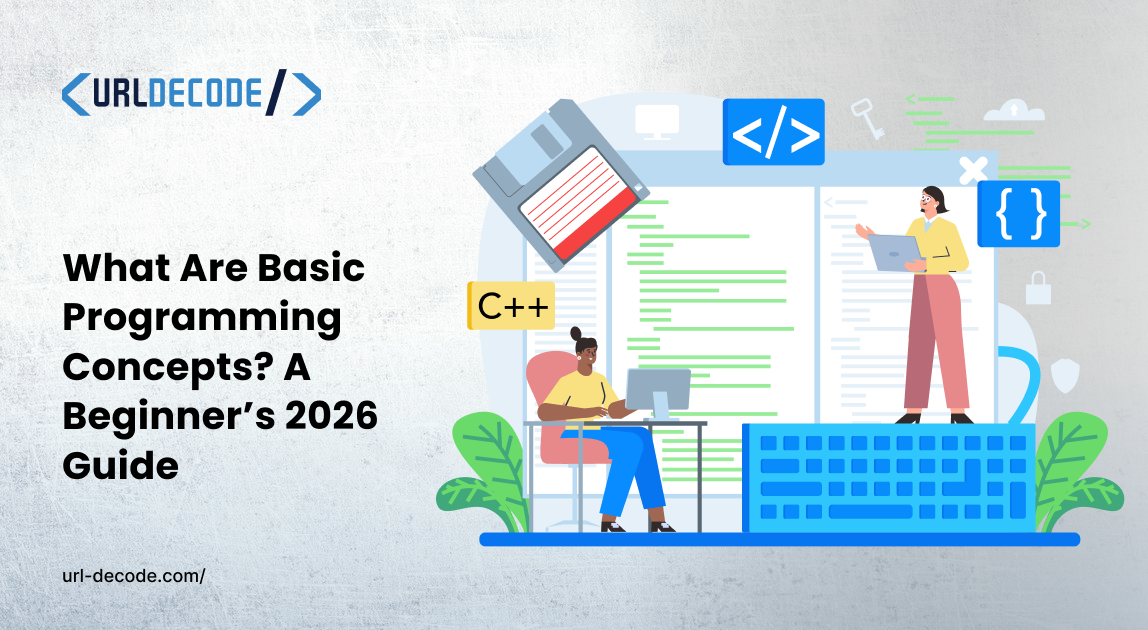
Before starting programming, the very first thing you should focus on is the foundation of all languages-that is, basic programming concepts. These core principles help every beginner and expert to solve problems, think logically, and develop software.
No matter whether you are learning JavaScript or Python, C++ or Java, or planning to develop a grip even on the hardest coding languages, you should always start with learning basic coding concepts. Without these, developers will constantly feel overwhelmed or lost.
This is a detailed guide for beginners to completely understand all the coding fundamentals.
An Overview of Fundamental Coding Concepts
Here’s a quick snapshot of all the top programming basic coding concepts:
|
Coding Basics |
Explanation |
Importance |
|
1. Variables |
Named storage for data values |
Enables programs to store and manipulate information |
|
2. Data Types |
Categories of data like: |
Helps prevent mistakes |
|
3. Operators |
Symbols or commands that perform: |
Allows logical operations and mathematical processing |
|
4. Control Flow |
Rules for making decisions and repeating actions, like loops or conditional statements |
It determines how a program reacts to different situations |
|
5. Functions |
Self-contained code blocks designed for reuse |
Makes programs modular, cleaner, and easier to maintain |
|
6. Arrays/Lists |
Ordered collections of multiple elements |
Helps manage and process multiple items at once |
|
7. Algorithms |
Defined step-by-step methods for solving problems |
Forms the core approach for efficiency and programming logic |
|
8. Debugging |
The process of identifying and correcting errors in code |
Useful for ensuring programs work correctly and efficiently |
|
9. OOP Concepts |
Principles like: classes |
Supports designing scalable and organized software systems |
|
10. Data Structures |
Ways to store and organize data, e.g., stacks, queues, trees |
Improves: performance |
Top 10 Basic Programming Concepts
Let’s get into the top 10 fundamental coding concepts one by one:
1. Variables
Every beginner starts with variables. They can be described as storage boxes where developers can store information, and later they can use it when needed. For instance, you can store a username, game score, email ID, age, or any other crucial data.
Here’s an example:
name = “Alice”
age = 26
is_student= tru
Your programs become dynamic with variables. If you don’t use variables, the software that you developed would be useless.
2. Operators
For data processing and manipulation, operators are used. It becomes easier to perform different tasks with operators, including comparing two values, adding two numbers, combining multiple logical statements, and checking if a statement is true or false.
Operators are of various types, including comparison operators, arithmetic operators, and logical operators.
3. Data Types
Data is classified into data types. Commonly used data types are float, string, Boolean, arrays, and integers. Once you understand them well, you will be an expert in avoiding errors and writing clean, structured code.
4. Control Flow
Through control flow, your program is enabled to make decisions and perform repeated tasks. The major categories are conditional statements and loops. Based on different conditions, conditional statements allow us to select a specific action. Here’s the example:
If age > 18:
print (“Adult”)
else
print (“Minor”)
Loops are there to repeat tasks automatically. If you don’t rely on loops, you have to write the same line of code again and again. Here’s a loops example:
for i in range (5):
print (i)
5. Functions
Your code becomes readable, clean, and reusable with functions. They act like small machines; you provide them with input, and they return output. They can calculate the area of a circle, show a welcome message, fetch information, and validate a password.
Here’s an example of functions for your understanding:
def greet (name)
print(“Hello” + name)
6. Arrays and Lists
Arrays allow developers to store many items, including a list of names, a complete menu of food items, multiple scores, and product items in a cart. Also, the information processing and organization of large amounts of data becomes easy with arrays.
7. Debugging
Anyone can make mistakes, no matter how experienced they are. Through debugging, they identify and fix errors. Usually, errors are of 3 types: syntax, runtime, and logical errors. Once you become proficient in debugging, it saves you a lot of time.
8. Algorithms
To address a problem during programming, developers follow a sequence of steps called an algorithm. Examples are searching through data, sorting a list, password validation, and suggesting a YouTube video. They also help you think about the best skills behind programming.
9. Data Structures
They are the modern form of data storage, facilitating adding, retrieving, or modifying information. Some popular examples include linked lists, trees, hash maps, queues, and stacks. When you understand the proper functioning of data structures, your programs become faster and higher-performing.
10. Object-Oriented Programming
Object-Oriented Programming (OOP), being the backbone of advanced software, helps you to structure code in a manner that resembles real-world items. Developers build classes, and then each class develops objects. Also, OOP helps in teaching concepts such as inheritance, encapsulation, and polymorphism.
Tips to Start Learning Fundamentals of Programming
To become a pro at programming, you can always start with basic programming concepts:
- Select one beginner-friendly programming language.
- Understand and learn all fundamental coding concepts.
- Start developing small projects like a calculator, a to-do list, or a simple game.
- Daily practice is key.
- Become an expert in debugging
- Learn about data structures and OOP.
- Learn tools and frameworks such as Laravel, Flask, Django, or React.
Conclusion
A real coding journey begins with mastering basic programming concepts. These concepts are the foundation, a clear map to follow, and a toolkit to utilize. Understanding loops, variables, data types, conditions, functions, and algorithms helps you in picking up even the hardest programming languages and creating meaningful projects.
Programming is a game of logic, problem-solving, and structure, far away from memorizing syntax. And skills enable developers to tackle every situation well. That’s the reason big companies prefer to hire full-stack developers who are skilled for their projects.