What Are the New Trends in Technology in 2026
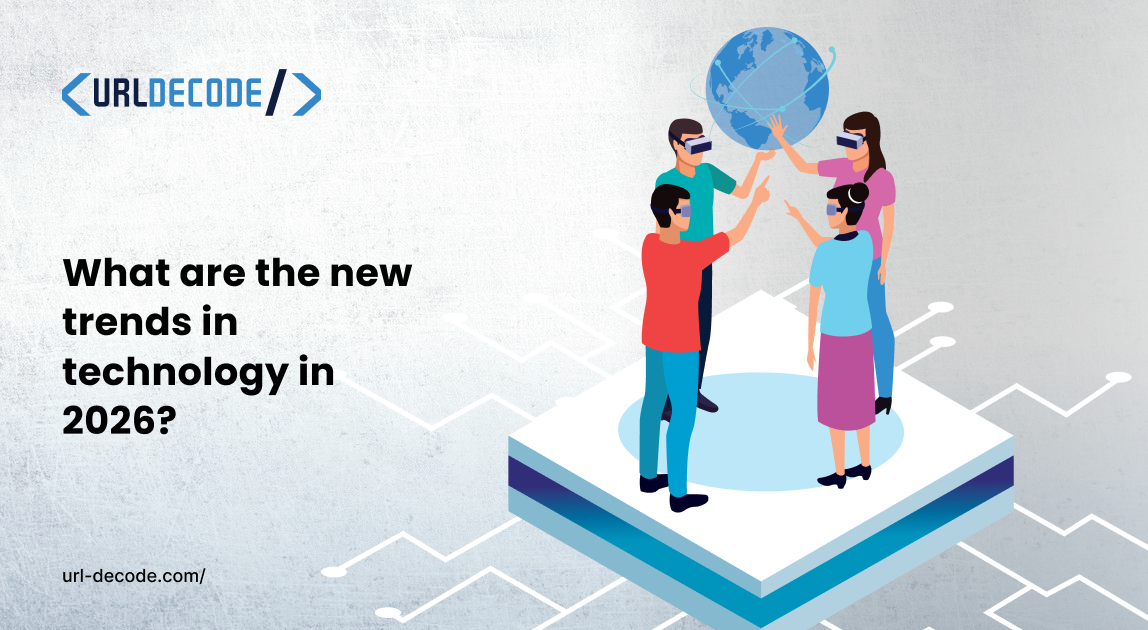
The new technology trends in 2026 mark a decisive turning point in our relationship with digital tools, moving from reactive assistance to proactive autonomy. While previous years were dedicated to experimentation and the discovery of large language models, 2026 stands out as the year of massive industrialization and invisible integration.
1. Agentic artificial intelligence and the end of passive tools
Possibly the most significant change of 2026 is the change from interface AI to fully agentic autonomous AI. In 2026, we will have moved past rudimentary conversations with an interface to delegating sophisticated tasks to the systems that act on our behalf, supported by advanced AI development services. These agents are more than mere content generators. They will be capable of managing supply chains, solving logistical issues without human intervention, and optimizing human resource processes, such as hiring and candidate management, through AI recruiting software.
Agent orchestration in the enterprise
Within enterprises, the discontinuation of departmentalized AI utilization is replaced with global orchestration. Ecosystems with multiple collaborative agents have been constructed.
For example, a sales agent can communicate with a production agent to make real-time adjustments to stock levels based on predicted production levels.
This type of agent interoperability eliminates information silos and allows companies to respond to changes in the global marketplace with unprecedented speed through AI agent orchestration.
Small language models and edge AI
In addition to large language models, the year 2026 will mark the successful achievement of Small Language Models (SLMs). These models are compact but are still highly effective, and can be deployed on mobile devices and industrial sensors.
This approach, commonly referred to as “Edge AI,” facilitates real-time processing of data and ensures low latency and improved privacy, as data no longer routinely traverses centralized servers.
2. The convergence between sustainability and high performance
Climate urgency has transformed "Green IT" from a marketing concept into an architectural necessity. In 2026, technological innovation is inseparable from its carbon footprint, a recurring topic of analysis on every Tech blog closely following the sector's evolution.
Data centers are no longer evaluated solely on their computing power, but on their energy efficiency and their ability to reuse waste heat to heat urban areas.
Sustainable computing and software eco-design
Digital sobriety ideas have been added to software development. Developers now utilize optimization algorithms to make code consume less energy while it is running. The industry is moving toward processors made with novel materials like gallium nitride. These processors work better and use a lot less electricity than regular silicon chips.
|
Field of innovation |
Major impact in 2026 |
Strategic priority |
|
Artificial intelligence |
Autonomous agents and SLM |
Orchestration and ethics |
|
Cybersecurity |
Post-quantum cryptography |
Data sovereignty |
|
Green technologies |
Low-carbon processors |
Energy efficiency |
Toward a circular economy of components
Recycling and reuse of technology components is becoming an area of increasing importance in the management of technology life cycles. Modular technology that is easier to repair and recycle is being created by hardware manufacturers.
In 2026, blockchain technology will be able to trace rare metals, ensuring that the materials that make up a smartphone or server are sourced responsibly and fed back into the production loop at the end of the life cycle of the device.
3. Cybersecurity in the era of post-quantum and sovereignty
Quantum computing will disrupt traditional methods of securing data. In 2026, there will be a large-scale transition to data security methods known as post-quantum cryptography. Governments and financial institutions are expected to secure sensitive data for the foreseeable future by using data protection measures that are resistant to quantum computing.
Cloud regionalization and digital sovereignty
The 'geopatriation' of data is getting stronger. Companies are pulling away from global clouds and using proprietary data as a source of regional sovereignty to avoid sovereign laws.
This search for cloud data regionalization empowers a growing number of regional cloud players who are able to provide highly confidential and locally bound, regionally-operated services, and are compliant with the AI Act in Europe.
Defensive AI and proactive threat detection
Cybersecurity is no longer a wall. It is now an active immune system. AI is applied to detect behaviors outside the norm, even before an attack occurs. Cyberthreats, with their growing sophistication, are analyzed in real-time and in a matter of seconds, automated network partitions are isolated, and patches are created to mitigate the identified vulnerabilities.
4. The integration of extended reality in the professional world
Extended reality, which includes both augmented and virtual reality, is no longer an entertainment resource and will soon become an important tool for added business productivity. By 2026, these headsets are to become lightweight glasses designed for remote collaboration and remote technical training.
Spatial collaboration and virtual offices
What US Clients Say About Cadronix shows that the advancement of hybrid work has accelerated 3D virtual office technology, where employees can engage as if they were physically present. This type of immersion fosters more organic brainstorming sessions and more sophisticated project visualization. Tools of this nature allow engineers and designers to work with digital twins (or twins of buildings), speeding up design cycles and cutting down on manufacturing errors.
Assisted maintenance and connected health
Maintenance technicians in industry use augmented reality to project repair instructions onto machines. Surgeons in healthcare use real-time imaging of the different layers of the body so that they can better control their hands. These examples show that in 2026, the available technology is still dependent on the human element and serves to assist the worker rather than replace them.
Internet Installation: The Foundation Behind Modern Connectivity
As new technologies like AI, cloud computing, and smart devices continue to evolve, the importance of reliable internet installation has become more apparent than ever. High-speed connectivity is the backbone that allows these innovations to function efficiently, whether it's supporting remote work, powering smart homes, or enabling real-time data processing. Modern installations increasingly rely on fiber-optic networks, which provide faster speeds, lower latency, and better reliability than traditional broadband systems.
A technological future between autonomy and responsibility
The technological trends of 2026 point to a world where artificial intelligence will be the invisible engine of the economy, shaped by the need for both security and sustainability.
The rise of sustainable computing, the expanding number of autonomous agents, and defenses against quantum attacks are all evidence that the business is becoming more mature.
Technology is no longer an end in itself; it is now a way to build strong and responsible businesses on purpose. The next several years will be hard because we need to find a way to balance the growing use of automation with keeping people in charge of systems that are getting more and more complex.